
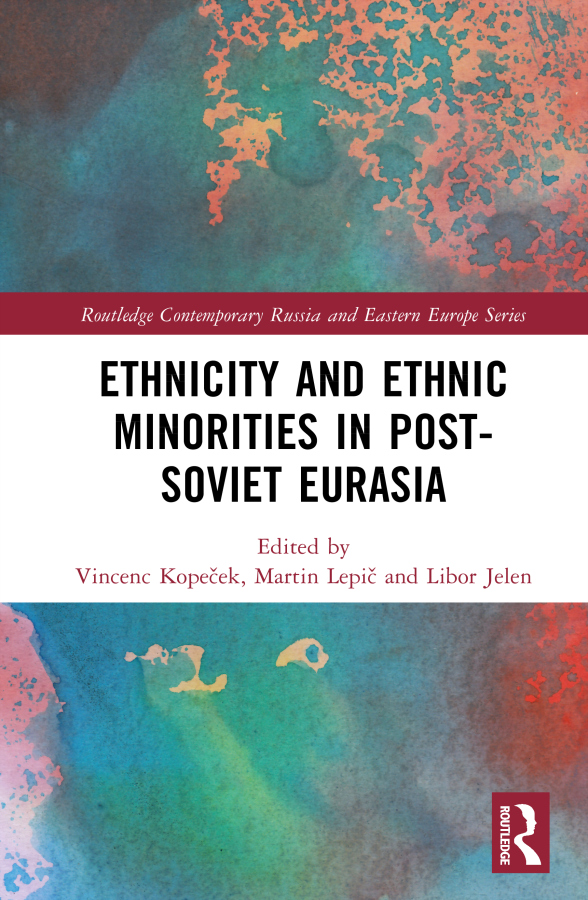
Ethnicity and Ethnic Minorities in Post-Soviet Eurasia
Vše od
Taylor & Francis
ISBN: 9781041099970
This book focuses on the study of ethnic minorities in post-Soviet Eurasia, their self-perceptions and their relations with ethnic majorities, and further arguing that the Soviet notion of ethnicity stood at the centre of Soviet administrative structure, thus impacting political institutions and ...
Chcete ušetřit? Najdete u nás i výhodné sady produktů.
Množstevní slevy pro školy i jednotlivce.
4 738 Kč
- 1 - 3 ks
- 4 738 Kč
- 4 - 20 ks
- 4 691 Kč
- 21 a více ks
- 4 645 Kč
Naše cena 4 738 Kč je o 5 % nižší než
doporučená cena výrobce 4 988 Kč.
Předpoklad doručení do 18. listopadu *
* Termín expedice je odhadovaný a může se mírně upravit podle termínu dodání od našeho dodavatele. Pokud by došlo ke změně, vždy vás budeme včas informovat.
Nepřehlédněte od Taylor & Francis ↓
4 738 Kč
Více o produktu ↓
This book focuses on the study of ethnic minorities in post-Soviet Eurasia, their self-perceptions and their relations with ethnic majorities, and further arguing that the Soviet notion of ethnicity stood at the centre of Soviet administrative structure, thus impacting political institutions and ethnic autonomies.
This book focuses on the study of ethnic minorities in post- Soviet Eurasia, their self-perceptions, and their relations with ethnic majorities and dominant state- and nation-building. Contributors to the book examine strategies and networks which minorities create for preserving a group’s distinctiveness while at the same time maintaining coexistence with the majority. The chapters also study the effects of different contextual settings of these strategies and networks. Offering a unique systematic comparison of selected cases using ethnicity as the main concept, the book argues it was the Soviet notion of ethnicity which stood in the centre of the administrative structure of the Soviet Union and that it consequently had a profound impact on how individual ethnic majority and minority groups in the former USSR understood themselves and imagined each other, how political institutions in individual Soviet republics and ethnic autonomies were formed, and how this institutional setting defined the distribution of political power between ethnic majorities and minorities. It also argues that this complex system of relations between ethnic minorities and majorities has significantly changed during the past 30 years and resulted in the formation of a post-Soviet notion of ethnicity. This book will be of interest to researchers studying Post- Soviet Politics, Political Geography, International Relations, Political Science, History, and Area studies.
Obsah
Introduction. Part 1 Theorizing ethnicity in the Soviet and post-Soviet contexts 1. Ethnicity in Soviet and post-Soviet states in context 2. Situations and strategies of national minorities in post-Soviet Eurasia: a conceptual and theoretical framework Part 2 Case studies 3. Between Kurdish nationalism and Yezidi ethno-religious exceptionalism. Identity split among the Yezidis in Armenia and Georgia 4. Like “plastic”? Ethnic ambiguity as a survival strategy among the Megrelians in the de facto state of Abkhazia 5. Between two states: the Lezgins’ struggle for cultural survival in Russia and Azerbaijan 6. The evolution of Azerbaijani Talysh identity: construction, deconstruction, and reconstruction across Soviet and post-Soviet eras 7. We were nomads. The influence of the border on the mobility of Georgian Azerbaijanis after 1991 and 2020 8. What went wrong? Reflections on the Komi ethnic movement 9. Contesting culture: state instrumentalization of Sakha traditions in the post-Soviet Republic of Sakha 10. Latgalians — contested identity through the past and the present 11. Identity narratives of the Rusyns in Transcarpathia since the dissolution of the Soviet Union 12. The Gagauz diaspora in Transnistria: preserving identity in a multi-ethnic environment 13. Koryo-saram — spirals of migration and transformations of identity 14. Kazakhstani Russians in transition: identity formation in times of uncertainty 15. Karakalpaks: entity with and without autonomy. Conclusion
- Výrobce
- Taylor & Francis
- Jazyk
- eng
- Autor
- Kopeček, Vincenc|Lepič, Martin|Jelen, Libor
- Obsah
- Hardback
- Rok vydání
- 2025
- Počet stran
- 222
Zanechte své hodnocení
Budeme rádi, když se podělíte o svou zkušenost s Ethnicity and Ethnic Minorities in Post-Soviet Eurasia a pomůžete tak ostatním zákazníkům při výběru.